

If you want to straighten your teeth, you have probably wondered whether clear aligners or braces are right for you. Both options work, and both move teeth in a controlled way when they are well planned and supervised. The question is not which one wins in general, but which one suits your case and your day-to-day life. At Nümia we help you understand the differences so you can decide with good information at your appointment.
How teeth move
Aligners and braces are based on the same principle: applying a gentle, constant force that, over time, takes the teeth to their new position. The bone around each root is gradually remodeled as the tooth moves. That is why movements are made little by little and checked regularly at the appointment: moving a tooth too fast is not good for the gum or the root.
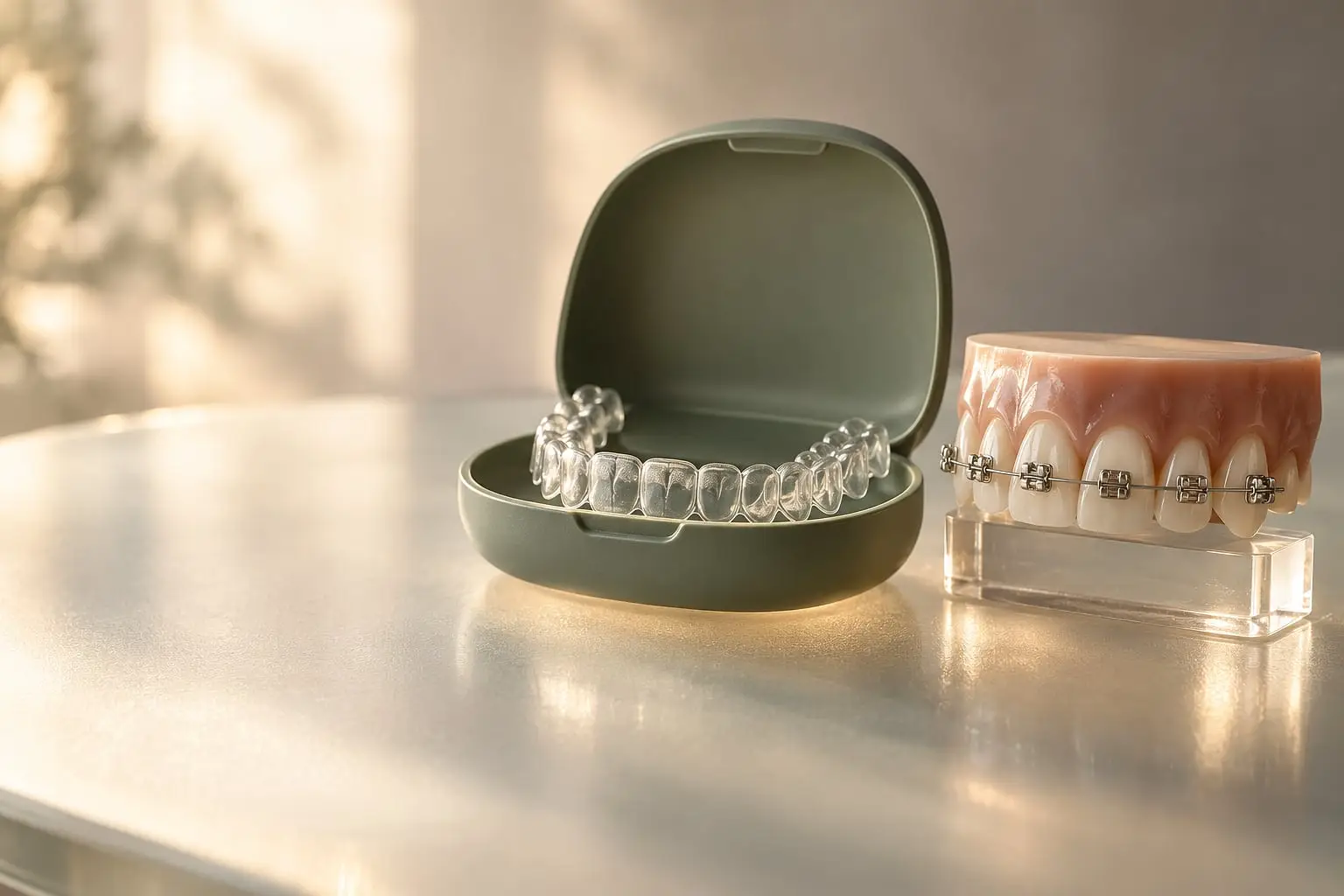
Clear aligners
Aligners are a series of clear, removable trays, made to measure, that are changed in stages. Each one moves the teeth a little, following a plan that is designed digitally at the start of the treatment.
Their clearest advantages:
- They are almost invisible when you smile.
- You take them out to eat and to brush, which makes hygiene easier.
- They tend to be comfortable for the cheeks and lips.
In return, they ask for something important: wearing them most of the day and night. If they spend a lot of time out of your mouth, the teeth do not move as planned. They work very well for people who are consistent and organized.
Braces
Braces are small pieces that are bonded to the teeth and joined with a wire. They can be metal or cosmetic, tooth-colored, so that they are less noticeable. Because they are fixed, they work all the time without depending on you remembering to wear them.
They are very useful in cases with more complex movements and allow fine control of each tooth. In return, hygiene takes more care, because food gets caught around the braces, and it is wise to avoid very hard or sticky foods that can loosen them.
How to choose
At the assessment we take several factors into account to recommend an option:
- The type of movement you need. Some cases are resolved well with either option; others call for one more than the other.
- Your habits. If you know it would be hard for you to wear aligners most of the day, braces may be more practical.
- Your lifestyle. Some people prefer something discreet because of their work, and others prefer not to have to think about taking anything out and putting it back.
- The check-ups. Both options need follow-up visits; we explain how often in each case.
We make the decision with you, after reviewing your teeth, your bite and your gums in the dental office.
If you have doubts, at the assessment you can ask everything you need about each appliance before choosing.
What they have in common
Whatever you choose, three things do not change. The first is daily hygiene: careful brushing and cleaning between teeth. The second is the check-ups, to confirm that everything is moving ahead as planned. The third is the retainers at the end: teeth tend to go back to their earlier position, and the retainer helps keep the result. Wearing them as we tell you is part of the treatment, not an extra.
When to see us
We recommend an assessment if:
- You have crowded, rotated or spaced teeth.
- Your bite does not close well or you notice wear on some teeth.
- You have had orthodontic treatment before and your teeth have moved again.
At Orthodontics we explain which option suits your case.