

If you are thinking about veneers, you are probably wondering what exactly happens at the office, how many appointments it takes and what care comes afterward. Knowing the process step by step helps you decide calmly and arrive at your first appointment with your questions clear.
In brief
- Veneers are custom-made coverings placed over the front surface of the tooth; they can be made of porcelain or composite resin.
- The process starts with an assessment: before any veneer, cavities or gum disease must be treated.
- In most cases a thin layer of enamel is removed, so the treatment is not reversible.
- Veneers need daily care and check-ups; they are not a solution for every mouth.
What is a veneer and what materials can it be made of?
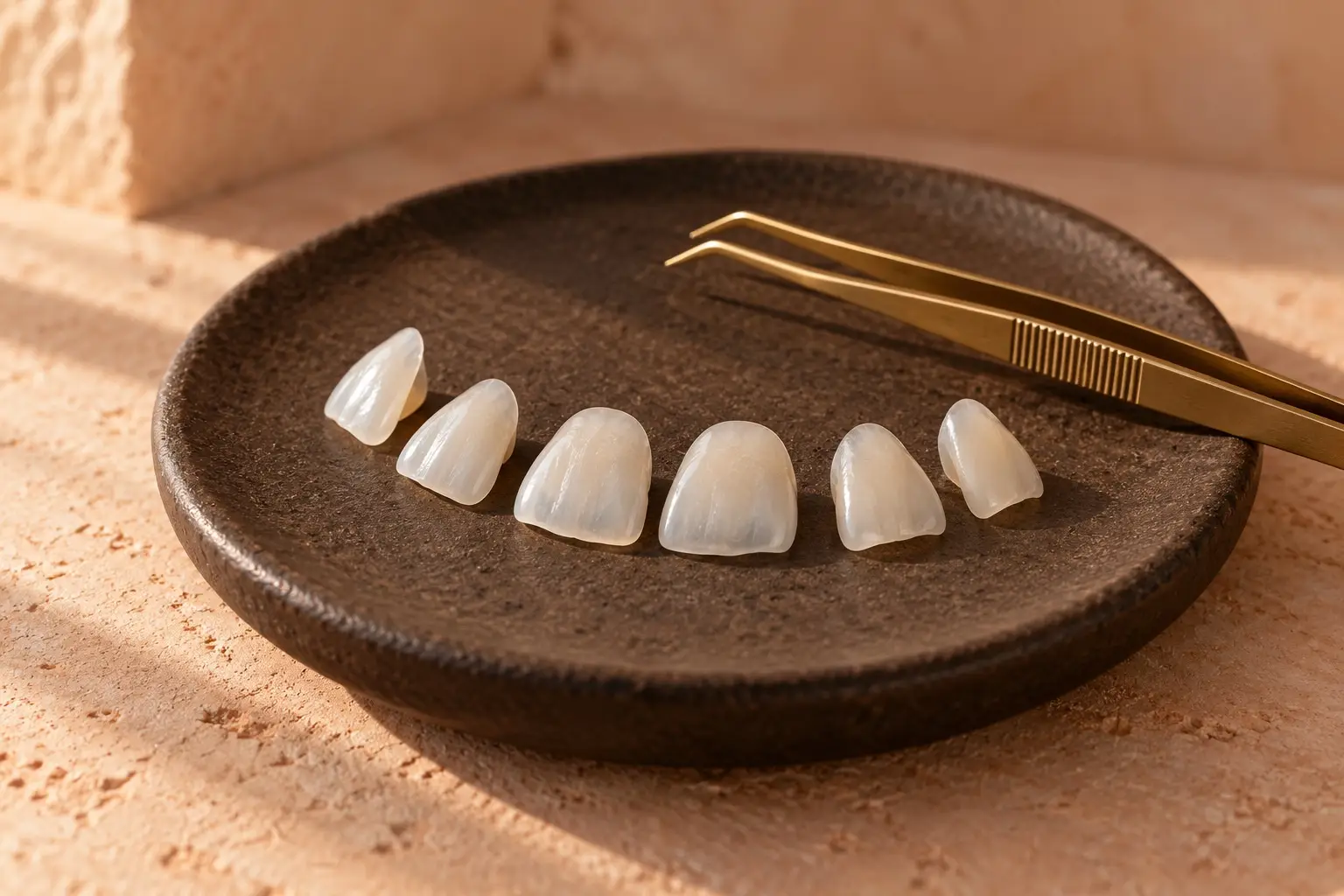
A veneer is a thin, custom-made shell that covers only the front of the tooth, unlike a crown, which covers it completely. According to the American Dental Association (ADA), it can improve the appearance of chipped or broken, stained, crooked or irregularly shaped teeth, and it can also disguise small gaps between them.
There are two main types. A porcelain veneer is a thin sheet made in a dental laboratory; it is strong and looks natural. A composite resin veneer is made with the same tooth-colored material used for fillings, bonded to the tooth and sculpted directly in the mouth; it may require less enamel removal and fewer appointments, although it resists staining and wear less well. Your dentist will explain which one suits your case.
What happens at the assessment?
It is the most important appointment, even though nothing is placed. Your dental history is reviewed, your teeth and gums are examined, and you talk about what you want to change and what you do not. The ADA stresses that before veneers are placed, any existing problem, such as cavities or gum disease, has to be treated, because placing them over teeth that are not healthy can make those problems worse.
It is also the time to talk about expectations, questions and doubts. At Nümia we evaluate your case before proposing a treatment and explain your options, including those that are not veneers.
How is a porcelain veneer placed?
In general terms, the process includes these steps:
- Tooth preparation. A small amount of enamel is removed from the front and sides so that the veneer fits.
- Recording the shape. An impression or a digital model of the tooth is taken, and the shade closest to your natural teeth is chosen.
- Fabrication. A dental technician makes the veneer to measure in a laboratory. In the meantime, you may wear a temporary veneer.
- Try-in and placement. The dentist tries the veneer to check its fit and shape. After any needed adjustments, the teeth are cleaned and the veneer is bonded.
With composite resin, the dentist prepares the tooth, places and sculpts the material, hardens it with a special light and polishes it until it looks natural.
What care do veneers need, and what are their limits?
Veneers can chip, crack, wear down or come loose over time, and then they have to be bonded again, repaired or replaced. To look after them, the ADA recommends:
- Avoiding nail biting and chewing on very hard objects or foods.
- Wearing a mouthguard if you play sports with a risk of impact.
- Moderating drinks that stain, such as coffee, tea or red wine.
- Brushing twice a day with fluoride toothpaste and cleaning between your teeth daily: you can still get cavities under or around a veneer.
In addition, if you clench or grind your teeth, or have a very tight bite, veneers may not be the right option. Finally, the ADA recommends that this treatment always be done by a licensed dentist, not by a technician without clinical training.
When to see us
Consider asking for an assessment if:
- You have teeth that are stained, chipped, spaced out or shaped in a way that bothers you.
- You want to change your smile but do not know which option suits you.
- You notice that you clench or grind your teeth, or your gums bleed, and you want to look into it before deciding.
In Cosmetic Dentistry we plan a treatment made to fit you. If you are coming from elsewhere and want to organize your trip, see our page on dental veneers in Mexico.