

When all the teeth in the upper or lower jaw are missing, or the ones that remain can no longer be saved, the question comes up: can the whole arch be replaced with implants? In many cases it can, but it is not a treatment for everyone, and it is not decided overnight. Here we explain what it involves and what the dentist evaluates before suggesting it.
In brief
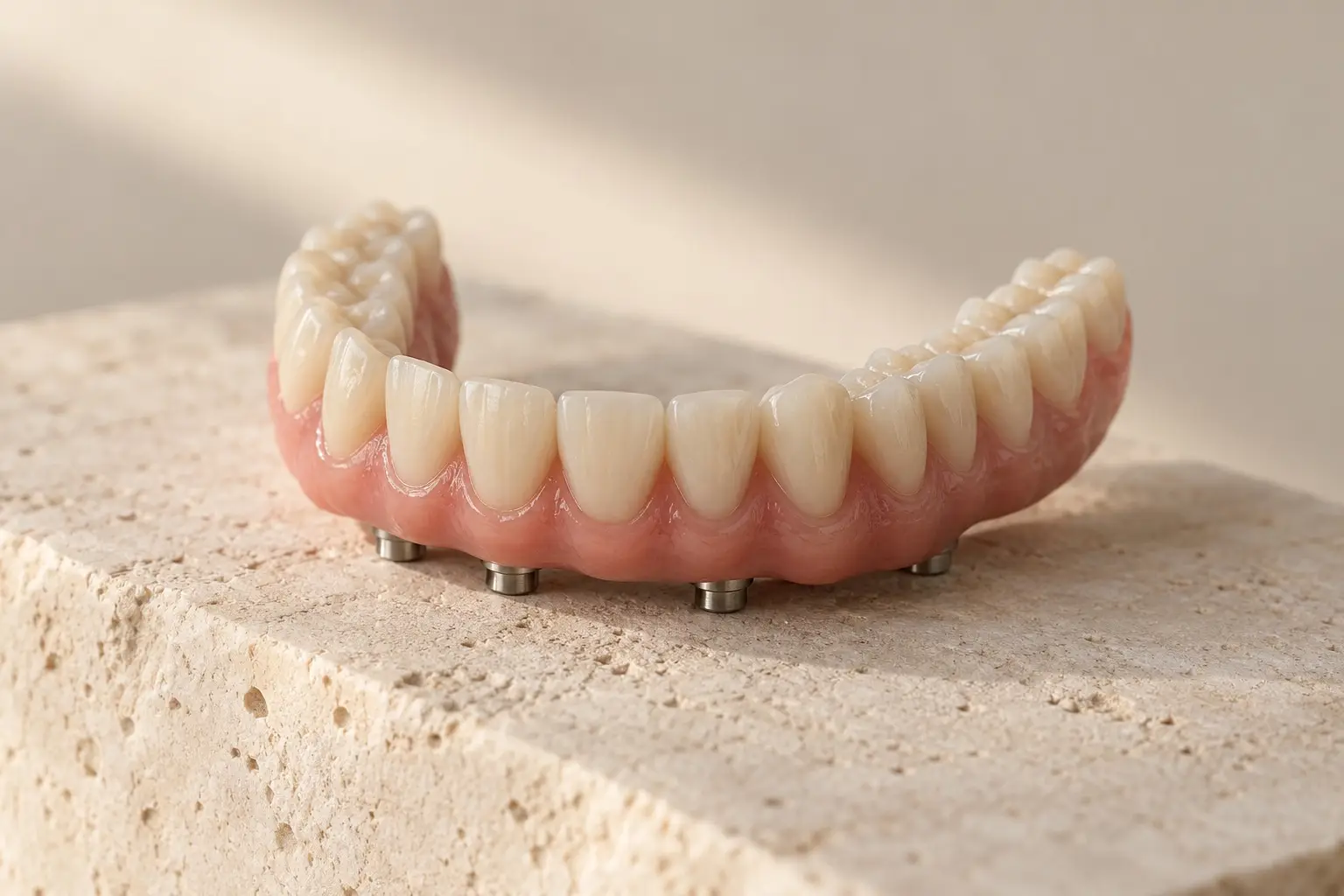
- A full-arch implant restoration replaces all the teeth in one jaw (upper or lower) with a fixed or removable prosthesis held by several implants, not one for each tooth.
- To be a candidate, your bone, your gums and your general health are evaluated; on its own, age matters less than your state of health.
- The process goes in phases: assessment, implant placement, healing and the final prosthesis.
- Timelines depend on each case; no one should promise them before examining your mouth.
What is a full-arch implant restoration?
It is a restoration in which a prosthesis with all the teeth of an arch rests on a group of implants. Implants are posts made of titanium and other body-compatible materials that are placed in the jawbone, where they work as an anchor for the replacement teeth, as the ADA explains.
The prosthesis can be fixed, which you do not remove at home, or removable, which you can take out to clean. Which one suits you depends on your bone, your hygiene, your bite and what you are looking for. It is a decision made together with you, with the alternatives on the table.
What is evaluated to know if you are a candidate?
Before talking about implants, the dentist reviews several things:
- The bone. Implants need enough bone to anchor into. It is checked with X-rays and imaging studies, and sometimes the bone has to be regenerated first.
- The gums. If there is gum disease, it is treated first. Left untreated, gum disease can spread to the bones supporting the teeth, according to the NIDCR.
- Your general health. Your state of health weighs more than your age. Sometimes a medical assessment is requested before surgery.
- Your habits. Smoking or using tobacco can slow recovery, and chronic conditions such as diabetes can interfere with healing, according to the ADA. Good diabetes control helps your mouth; the NIDCR notes that diabetes can slow down healing.
This does not mean that someone who smokes or has diabetes is ruled out. It means your case is evaluated more carefully and, often, together with your physician.
What does the process look like, phase by phase?
The ADA describes three phases; in a full arch, the assessment comes before them:
- Assessment and plan. Medical history, an examination of your mouth and imaging studies. We explain the plan and its alternatives, such as a traditional removable prosthesis.
- Implant placement. The dentist places the implants in the bone through surgery at the office. Afterward, you receive instructions for eating and hygiene.
- Healing. The bone grows around the implant and holds it in place; this process is called osseointegration. The ADA says it can take up to several months in some patients, while others receive implants and teeth in a single visit. Which option applies in your case is defined by the assessment, not by a promise made in advance.
- Final prosthesis. It is designed to fit you, in size, shape, color and fit. While it is being made, the dentist may give you a temporary prosthesis so you can eat and speak normally.
What results have been observed?
A systematic review published in the Journal of Clinical Periodontology analyzed full-arch restorations in people who lost teeth mainly because of periodontitis. It found that implant loss during the first year was low with both fixed and removable prostheses, and that at five years there was a trend toward better results with fixed ones. The authors themselves point out that the data are limited and of low quality.
The same review reports that inflammation around the implant, called peri-implantitis, affected a significant share of the people with a fixed prosthesis. That is why follow-up and hygiene after treatment are part of the plan.
What care does it need afterward?
- Daily cleaning of the prosthesis and of the gums around the implants, using the techniques your dentist teaches you.
- Regular check-ups, which allow inflammation to be detected in time.
- Avoiding tobacco, which slows recovery.
When to see us
We recommend scheduling an assessment if:
- Almost all the teeth in one arch are missing, or the ones that remain are loose.
- Your removable prosthesis moves, hurts or keeps you from eating comfortably.
- You have swollen gums that bleed or bad breath that does not go away.
At Nümia we evaluate your case before proposing a treatment. You can learn more at Dental Implants, and if you are coming from outside the city, on dental implants in Playa del Carmen we explain how to plan the assessment and the appointments.